‘Beyond the Pale’. by Bruce Robbins and Jo Baer, Real Life Magazine, NY, First Published Summer, 1982
Jo Baer and Bruce Robbins started working together in 1978. Before this (in 1975 and 1976 respectively), they had changed the formal content of the work that they were previously associated with (Minimalism from the early Sixties in Baer’s case, Conceptualism from the late Sixties in Robbins’). In the summer of 1982, they moved from Ireland, where they had been working in collaboration for four years, to London, where they are at present continuing to work. The move from comparative rural isolation to an urban setting allowed questions on their work, reasons for changing, the nature of collaboration and thoughts on living in Ireland. The following remarks were in answer to such questions.
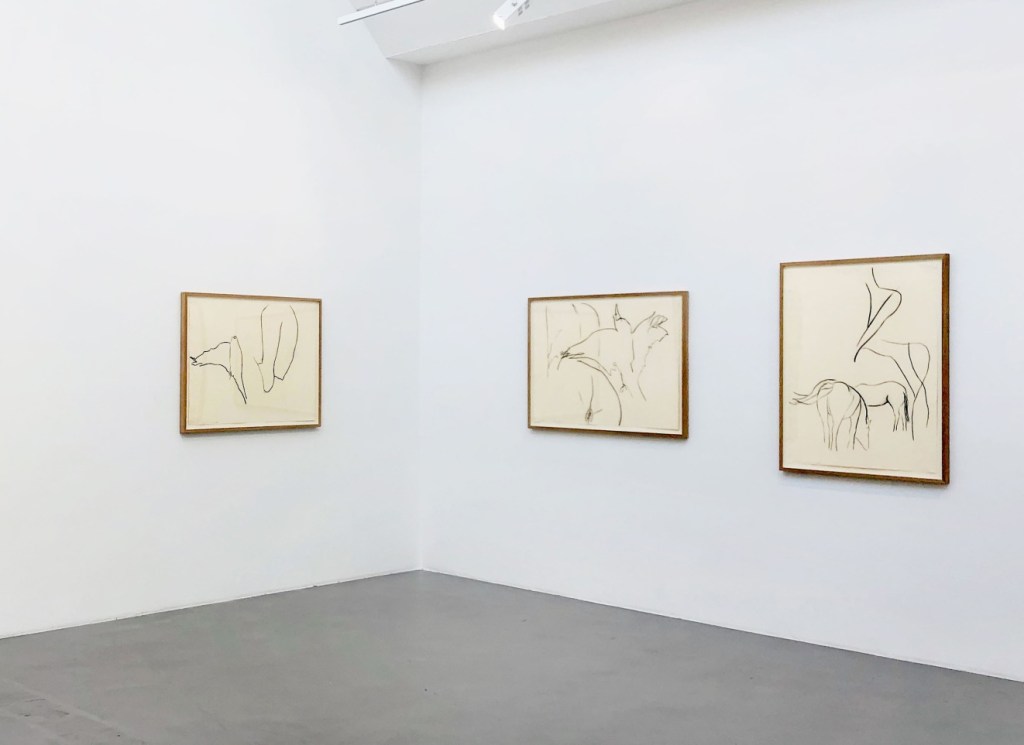
Partial figures (being partial to parts of figures) abound. Figures that occur as part swift and part powerful haunch, turning haunch and turning hand, hung in flight, swimming fur; figures that occur as part twisted iron, coiled skin, cut wood; figures that arise as arched female of the night, the bending dragon-lady of the day; that are as diagrams from carved stone or curved sky. The objects are useful and unmediated. The animals are familiar and unfamiliar. The women bridge continuity. Drawings gather these into coherence, the space where the winds meet. The winds meet in a classical place where structure is of more interest than style, where there is stillness and contemplation is beyond contempt. The common ground… a particular use of space, a space which is not an illusionistic paint-space but alludes to a painted space, not a pictured space nor a fantastic (dream or nightmare) space nor a fractured (cubist) space. This is established by or combined with particular colour; of light and less light, of transparent seas, one stained light and delicate in appearance, but hard and bruised in application, the other, a hard, glazed light, dark and sombre in appearance but applied with a gentle and bleeding hand.
A severed hand… an island is a good place from which to judge distance: how far the American supermarket? How near the Continental graveyard? How close is Britannia’s empire? Moreover, how far popular expression, how near the nationalistic expression of indulgence, how close the Philistine? An island where far off is overheard the cries of the wounded, the grunts of that mating of the individual to the nation, the lonely sighs of the self-abuser. On this island the severed hand saw and heard all of this yet could move with impunity, and from this hand falls the spawn of internal dialogues, external debates and the conversation between created objects, get which are now abroad.
Other generations: the notated eidolon from afar is not prohibited from being contemporary unless it is stolen as an antique. And sentimental time is not important but time to look at the trees and to watch the fire is. Connected with time is a feel for scale, and scale is framing, which is relational. Birth and death are always the same, never history despite being recorded, always framing, sometimes ostentatious, sometimes hidden…as subject matter gender is a more precise measure than sexuality. Matriarchy and patriarchy determine culture more than fucking ever did.
Salmon leaps or Utopian plunge? Steeplechasing from point to point: from razor cut to smudge, open to closed and close to open, titanium to mars, opaque intellect into sensual clarity, dragon’s teeth fabled suspension to Cadmus’s sowing the dragon’s teeth.
These are workaday oppositions, take-off and landing points from which to make saltatory leaps lacking illusions of continuity. Alternatively, the idealistic plunge replete with diving heroes: romanticism projects a state with the unfortunate belief that it can break free from its own mortal place. And equally all at sea is the materialism that has forgotten its birthright: its heritage of depth in favour of either the flotsam of its objects or the jetsam of its ideas.
On offer, classicism…always a prisoner of a state, unfortunate, but nonetheless true. Turn and turn again, all that’s left is to turn under by fooling with the footing. Beneath the feet of a statue is not only a pedestal but the notion of a real woman inside the cast. In objects more contemporary than statues of the goddess, there is still thought to be the nonfictional structure of the world enclosed by or encased in the cube, square and circle. Most recently, it is thought that using identifiable consumer objects and images (whether consumed or consummated) maintains a reality borrowed from those represented goods. This belief in verisimilitude is inherent in literal representation. It is a use of language which is always nonfigurative and a use of figures that are never used figuratively. Things and events in themselves cannot be repossessed; they can only be alluded to, for art is a deception, not an illusion, a pleasure and not a purchase. And what better way of dealing with deception than by using that which is illusion… Painting, the many-husbanded Queen.
In 1978, a new and an old world accent repaired to the third world to learn songs of The Internationale in a Pan-Atlantic dialect; that is, the raven and the panther entered into intercourse and interchanged. Shifts of figure and space spinning between equivalence and correspondence are bound to be a proper subject for painting.
London, 1982
R E A L LIFE issue 17
 Bruce Robbins
Leave a comment