Horse Pictures: a Review written by Ted Castle for ART MONTHLY.
Works by Jo Baer and Bruce Robbins, Mary Boone Gallery, New York, March 1982;
Lisson Gallery, London, Feb 23-Mar 20 1982;
Riverside Studios, London, Apr 6-May 1982:
In the Land of the Houyhnhnms (1735) in which the indefatigable Gulliver ends up on a planet where horses (who, he avers, never disagree with each other) run the strangely cultivated yahoo from another world with great compassion and teach him all they know. Even in such a context, where horses are elaborately admired as a foil for a satire of human evil and folly. The horse version of the United Nations Organisation turns out to be pretty dull, like the real thing now 250 years later. It is notable that Swift published his book in Dublin and that the first horse show was held in Dublin and that Jo Baer and Bruce Robbins, who love horses, live at Swarmore Castle in County Louth where they perhaps spend as much or more time with their horses every day as they do with their paints and brushes.
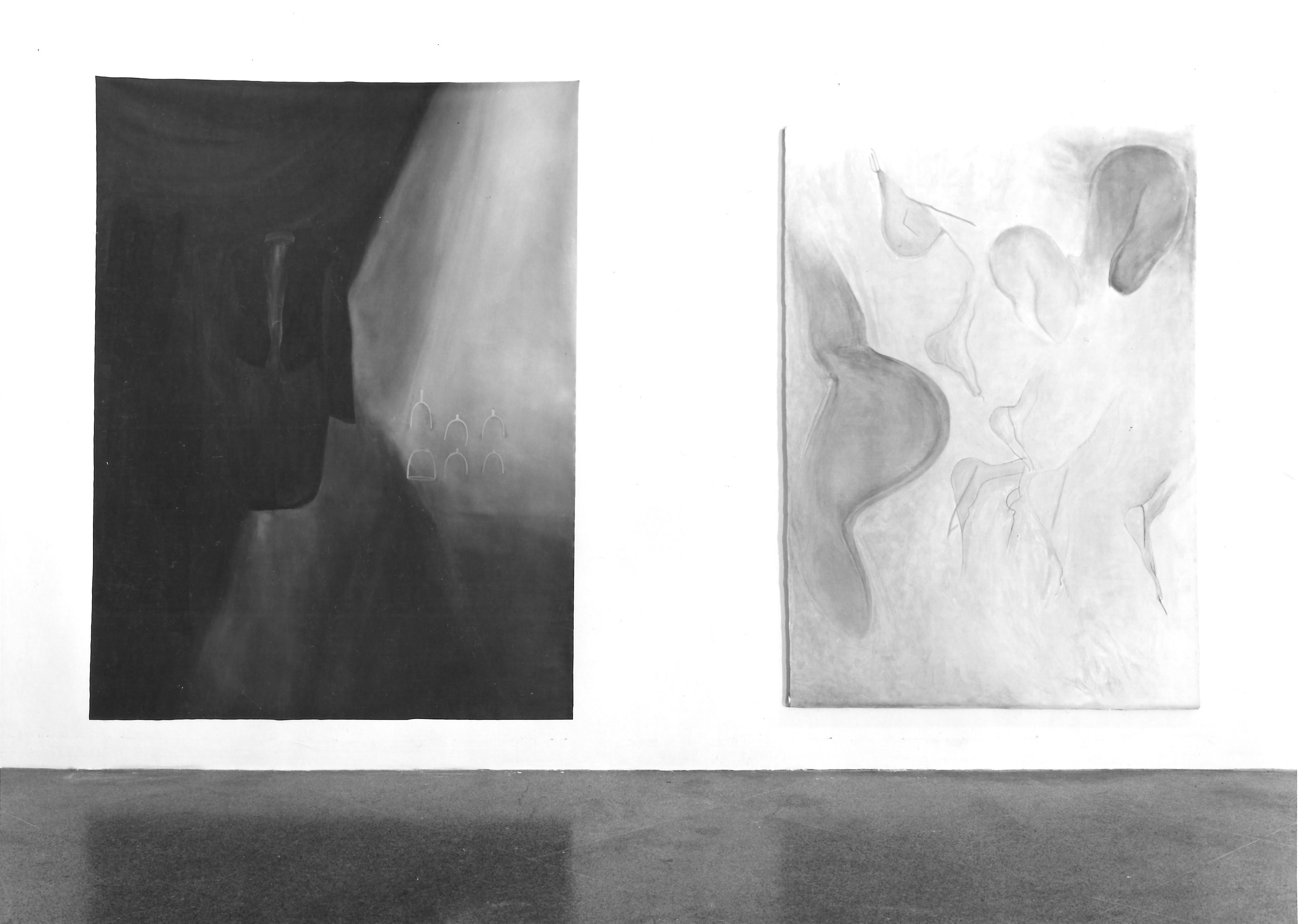
In March, Mary Boone showed four horse pictures in New York, two dark ones by Bruce Robbins and two light ones by Jo Baer, oil on unstretched canvas, all six feet wide and eight feet high. Their work has also recently been shown in London at the Lisson Gallery and Riverside. These are not the usual horse portraits painted of yore.* Robbins’s Iphimedia has a horse walking away toward the top of the picture.
Renverse (explained as a horse term meaning tail to the wall but used for an unusual punishment in which a man is forced to ride facing the tail of the horse) is the least of them.
What is there about horses? They are beautiful. Their beauty consists in their tractability combined with their physical power and their independence and, some would say, their intelligence. While not wishing to deny to horses, elephants, dolphins, dogs, cats and owls a high level of mental acuity bordering at times on the uncanny, I doubt those who insist that the onboard computers of animals include properly intellectual functions. As the old saw goes, the difference between a man and a dog is that the dog doesn’t know he’s a dog. Horses, though, have been in a special class ever since we domesticated them possibly as long as 5,000 years ago.
It was only in the 19th-century, however, that horses became commonplace in human life, a heyday of brief duration. Today most people seldom, if ever, see a live horse. I always like to look at them because I feel that I remember them from somewhere. Although they are herbivorous, and hence fit for human consumption, they are usually eaten only in emergencies or by our pets. There are really no wild horses anymore, the mustangs being descended from domestic animals who ran away. In the Oxford Dictionary there are fully thirty columns of information concerning words related to horse.
Curiously, the quotations concerning actual horses from the literature of all ages attest mainly to their existence rather than their servitude in his famous A Voyage to horsy of the pictures. A cougar, lion or other big cat chases the hind of an animal across the top of the picture, and in the lower part we do perhaps see the image of the characteristic horsetail that would be the view of a reversed rider. Then again, that is perhaps not what we see there. This white painting with blue and yellow drawings in very light tones is difficult to interpret even if you are standing in front of it as I did several times. It is somewhat like the paintings Baer showed in N.Y. two years ago, in a two person show with Robbins, at White Columns but those were, she told me, directly inspired by picture-books of ancient cave paintings. This one has the air of a narrative fragment rather than being evocative of a prehistorical.
‘Traverse’, also a light picture, certainly shows parts of horses and looks more like a cave painting, although there were no horses in cave paintings because horses were unknown in Europe thousands of years ago. Traverse is explained as meaning ‘head to the wall’, but Oxford only comes up with traverse meaning to bestride a horse or to ride it sideways, as horses will sometimes step. Whatever the title indicates, the picture shows a horse’s thigh and leg and tail, a head, some hooves and legs and at the bottom three pairs of testes in scroti, and at the top of the picture, ten different vulvas not apparently connected to any horse or other body, several of them exuding a blue line of paint. Also looking like an anatomical sketchbook, this picture might well be called ‘nightmare’ because that word means to dream of suffocation from being sat upon by a female Equus.
Robbins’s painting ‘Aganippe’ may represent the rear of a horse called that, but none of my primitive reference books disinters the apparently classical referent. His greens are seductive, his oils almost wash the lighter ground with deep colour that remains translucent. Except for parts of the horse, not much is identifiable except perhaps, at the top, a renverse human teat. All in all, I think these pictures show the world as horses might view it, full of light colour, soft grades of object fading into object, indecipherable human activities usually centred about a perfectly clear view of the other horse’s arse.
Ted Castle
Review written for ART MONTHLY
* footnote: ————————
Aganippe (/æɡəˈnɪpi/; Ancient Greek: Ἀγανίππη: ‘mare who kills mercifully’ – attached to an aspect of the goddess Demeter (worshipped as a black-winged mare) and the wife of King Acrisius of Argos. Aganippe was also the name of a spring considered to be a source of poetic inspiration.
Iphimedeia (/Ἰφιμέδεια:/; Ancient Greek: ‘she who strengthens the genitals’ – she fell in love with Poseidon, god of the sea, and would sit by the water, gathering water in her lap, and by this method she became pregnant by the god.
———————— BR 2026
Leave a Reply