By Jan Wandja. ZG Magazine, No. 7 Desire – Published by ZG Magazine London, United Kingdom, 1983

On leaving the exhibition, I glanced through the visitors’ book. Three viewers were provoked to add their comments.
One described the show as ‘beautiful celebratory ‘, another as offensive, and the third as “sexist”. For me, in a word, the work of Jo Baer and Bruce Robbins is equivocal; it is spiced with the double edge. There is a continual play on meanings through images and titles. The recurring whip, for example, hovers between being a symbol of power and cruelty and the S/M fetish of pleasure. What is rather unique is that here we have a couple creating erotic art, normally a male domain. It is significant that the results of this collaboration centre on an equivocal edge.
“Sexual organisations are metaphors: a play or interplay of organs a play or interplay upon meanings, – a play upon words”. (Norman O. Brown: Love’s Body.)
For Roland Barthes, eroticism manifests itself through the play of language. The double meaning, unified in the pun, becomes the divided fusion of eroticism. In Jo and Bruce’s work, the dissolve of one image into another — the ambiguous presence of two forms suggested by a single line — gives their work a double-edged presence. The ambiguity of their own individual presences in the work (or manifestation through it) gives it a correspondingly Janus-like quality. The female in their paintings is always headless. A torso and the line of her body that could lead to, and define the head, end in an unformed area of paint — or are invaded by the surface of white paper. The point at which the line ends is the point where being itself gapes. The dissolve of line is the “staging of an appearance — as disappearance”. (Barthes: The Pleasure of the Text). But headlessness is not a mutilation; rather, it is a lack of boundary, suggesting a loss of identity — or perhaps more a dissolve of self. ‘What pleasure wants is the site of loss — the seam, the cut…” a “dissolve which seizes the subject in the midst of bliss” (Barthes)
The artists’ use of the unfinished line or edge can be seen as a metaphor for the dissolve of self. The line of the thigh plunges into the void or blurs to an onrush of colour. A dissolve can only occur against an edge, and even in a union of two, there is always the edge of self, expressing a divided fusion.
In contrast to the dissolve of female figuration, the scythe, the whip, and the walking stick (the male elements) appear, at times, as fully circumscribed objects. In La Bouche Murmure (Jo Baer), a symbolic narrative emerges from the image of the scythe tabulated alongside the torso in Rokeby Venus recline.
The narrative is enhanced by the dressage title, which describes a horse foaming at the mouth. Although there is no horse in the painting the verbal and visual interplay evoke the myth of Aphrodite (‘aphros’ the Greek for “foam’), born of the ‘foam’ of the ‘lecherous members’ of Quarenes, whose son Kronos castrated him with a sythe.
In ‘Renverse Head to the Wall’ Baer) – There is a play between the female, highlighted as dissolving figuration, with the fully circumscribed symbolic female represented, (so the artist informs me) by the Etruscan emblem for the vulva. The emblem appears like a row of red tulips. In Traverse (Head to the Wall), it appears scattering like autumn leaves.
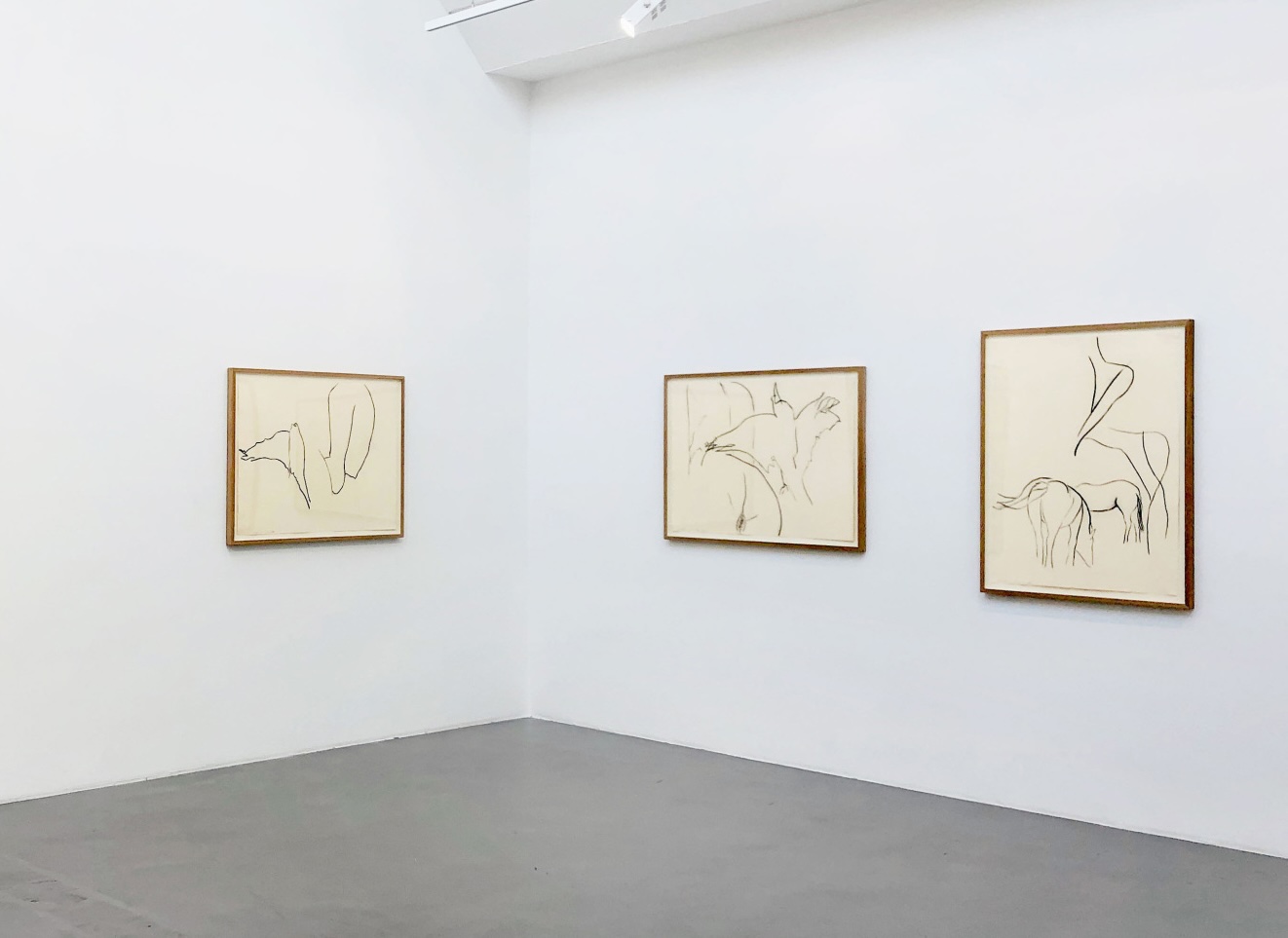
This interplay between emblematic and figurative female recurs throughout their work. At times, her torso is no more than an elbow-bending curve that has the simplicity of an erotic ‘C’. Or her figuration – a minimal linear evocation – approaches the abstraction of a mathematical symbol, similar to the Palaeolithic writing of the vulval triangle. The genital seat of shame is reduced to a mathematical symbol. “We do not read everything with the same intensity” There are not only warmer parts in the paintings, but, by virtue of their equivocal nature, they are uneasy parts. Such is the nature of the horse-female analogy. Although the parallel is aesthetic, it remains an uneasy one, fraught with equivocal meanings which vibrate in the presence of the whip: the female is ambiguously a stupid animal to be whipped into submission like a horse, or her animality is emphasised as that aspect of her nature that will never submit. Bending on all fours, she hovers between submission and defiance. She elicits admiration mingled with contempt – a mixture of feelings that has characterised mankind’s attitudes to females and animals throughout history.
On all fours, she bends in defiance to the stance of power which Kafka referred to as the “terror of standing upright?. It is only on the ground, among the animals, seeing the stars, that one is free from this terrifying power of man. When this female, revealing her vulva like an emblem, is contrasted with the figurative female in the horse analogy, those extreme, historical attitudes are expressed: she is no more than contemptible chattel — or she is the symbolic female who was worshipped as sacred in the ancient world. Originally, Aphrodite was no more than a 3-dimensional version of the vulval triangle, worshipped as a conical stone. She was “Aphrodite Philom-medes — Aphrodite the Lover of Genitals — a fact we may forget in our deference to the Venus of Botticelli or a naked girl by Modigliani”. (Geffrey Grigson: The Goddess of Love).
“In the unconscious, cerebral is genital. The word cerebral is from the same root as Ceres, goddess of cereals, growth and fertility; the same root as ‘cresco’, to grow and ‘creo’ to create”. And through an archaeology of language, the “prehistoric image of the body” is unearthed to reveal how “grey matter of the brain, spinal marrow and the seminal fluid are all one identical substance, on tap in the genital and stored in the head”. (Norman O. Brown: Love’s Body).
The nude, which embodies everything we desire and everything we most fear, remains the source of our deepest pleasures and traumas. Freud has argued that shame and sexual repression came with men adopting the upright position. And when the female in the position more canino – (in medieval times punishable by seven years of penance) — is put in an erotic context with a horse, an area of taboo is touched on. This taboo affected horse-riding etiquette: ladies rode side-saddle and were not allowed to ride stallions at sporting events.
The horse has often been used as a focus for erotic fantasy. In Equus by Peter Schaffer originally a play, later a film, the young hero is only able to find sexual fulfilment when riding horses while naked. In a series of sculptures by Marino Marini of horse and rider, the horse’s neck and head are a ‘phallic’ metaphor; in his Angel of the Citadel, the ecstatic horseman has an erect penis.
Kenneth Clark has said, “All good nude painting is sexually stımulating… No nude, however abstract, should fail to arouse in the spectator some vestige of erotic feeling — even though it be only the faintest shadow – and if it does not do so, it is bad art or false morals”. But how different is the female response from the male response to erotic art?
How does one feel when one is confronted with a human nude that is half animal or fish, such as those legendary satyrs, centaurs and mermaids? In Animals and Men, Clark distinguished the aesthetic appeal of the Greek combination (i.e., lower part animal) from that of the Egyptians (bird or animal head and human body). Yet though aesthetic, this horse/female analogy in Bruce and Baer’s paintings resounds with equivocal meanings.
In The Snatcher (The Collector of Genitals) by Bruce Robbins, the female appears with the image of the falling bird: Flying is an erection dream… with the body as phallus”. (Love’s Body). But here, the bird is seen as a reversal of the metaphor of flight, schematically plunging downwards, headfirst, until it finally folds its wings in a state of collapse. This image remains remote in comparison to the horse/female analogy. Is this reversal of flight a play on the female seen in reverse, or do we see the tired ‘bird’ that collects genitals like a jackdaw collects jewellery?
In Bruce Robbins’ predominantly green paintings, broad areas of colour bring the fragments of images back into the picture space, while Jo Baer’s fragmentary areas— a passage of galloping hooves, an area of copulating lines – come forward through the light washes of paint. The dressage title Tail to the Wall, neatly summarises the recurring images of horse and female, literally, with their tails to the wall. In Traverse, (Head to the Wall the line forming the back of the female becomes the vicious edge of a spiked and barbed wall, trapping her in all-fours position where she is rudely abused with lewd lines and sticks. Their canvases are stretched directly against the wall, like skins. The dissolve of figuration, the dissolution of self eroticism, is inscribed upon the wall of skin. The skin is the locus of sexuality. It is the same thin wall which divides, and yet excites them to overcome their separation. The wall is a line between in and out, as skin is between self and other. But the spatial metaphor so easily reverses (and reveals its double-edgedness).
The lines of the drawings are, at times, hesitant, at others, assertive, sometimes definite, at other times dissolved. The edge which the line divides and unifies represents a boundary both in terms of what is represented and what they present of themselves in this unique collaboration.
Jan Wandja
Published ZG Magazine, No. 7 Desire – Published by ZG Magazine London, United Kingdom, 1983

Leave a Reply