A Piece Written by Jo Baer in 1984 but not published until 2010, when it was included in Broadsides and Belles Lettres

This is the first (and last) art-critical writing I’ve ever done. Arriving directly in my new ‘stamping ground’ in the Netherlands from inclusion in R. Fuchs’ groundbreaking christening of the Castello di Rivoli (Turin, 1984), Italy’s first contemporary art museum in Torino. I found myself adrift waiting for my studio and my gear from London. What to do? Providentially, a portable typewriter under arm plus much free time allowed me to ponder on what was a remarkable and memorable exhibition. But unfinished – (Studio and equipment arrived).
Castello, 1984 If today’s political climate with its continual motions to the right has had any beneficial effects at all, one of them would be its destruction of some rather quaint idealisms relating the artist to the state. By misadventure (or design, perhaps) the covert power of the state to control the arts has recently come into clear view, overriding the aggressive political aesthetics of artists of the ‘70s with considered, state-originated aesthetic policies. For the first time in the West since the ’30s, deliberate and visible manipulations can be seen which project preferred audiences and sanction certain kinds of artists (making a change from when the artists, and still in some parts of the world the students, thought they were running things).
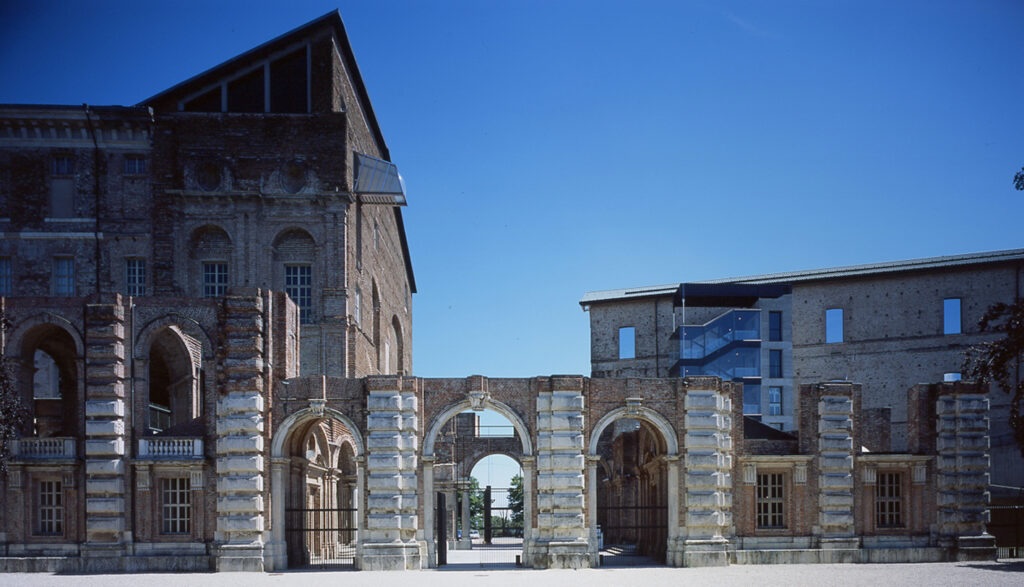
Along these lines in Southern Europe, December, 1984, conservation and the radical met and once again joined, this time in an alpine modern-art-palace where beauty, quality, the elite and the classical, classics of painting and sculpture (but not of classicism) regained their old hegemony and charisma in a superb exhibition mounted in a somewhat recent castle somewhere on the outskirts of Turin, Italy. This event was directed, begged, borrowed, and curated by the 1982 Documenta director Rudi Fuchs and inaugurated the Castello di Rivoli, Italy’s first contemporary art museum. The show remains intact and in place for one year and selected works will be bought from it to begin the Castello’s collection.
Given the high art quotient of greater Italy, the words “beauty, quality, classical” in this context are not surprising. Given the city of Turin’s initiating Communist government, these same words bewitch the optimist and fascinate the casual visionary in their implications for one possible future’s shape. Listen to the Assessore alla Cultura della Regione Piemonte: “Rivoli Castle is…planned and pursued as a flight from provincialism or fashion, as a challenge to the merely temporal…to create an Italian museum of modern art…that refuses to glorify the ephemeral…” It is ironic that Fuchs was the chosen instrument for this high cultural policy. At around the same time and in his own Social-Democratic Netherlands, his Dutch compatriots (unexpectedly) declined to appoint him the new director of Amsterdam’s prestigious Stedelijk Museum because of these same high-flying commitments to quality art and exhibitions. During the electioneering he was, in fact, accused of a partiality for beauty, for the artist, for high art and for the high-brow.(Clearly high performance can be high risk these days). The rival appointee Wim Bierens, originally from Bern and lately from the Boijmans Van Beuningen Museum in in Rotterdam, was voted in in particular contradistinction for his history of popular, crowd-pulling shows: i.e., “Sonsbeek,” Holland’s “When Attitudes Become Form” three years on; large Beuys demonstrations; numerous Graffiti incarnations and other such delectations to the public’s taste. Bierens has also said Pop Art will be a part of his new program, and one can’t speak more plainly than that.
Tastes aside, the contrasts between these two men and their intentions are unfortunately less pretentious than portending. Directors who do quality first-class shows know they must also make popular ones (attendance figures do tell tales). Directors who only do popular shows think they’re already doing quality first-class shows (for them attendance figures also tell tales). As everyone knows, the Dutch people regard culture very seriously. Sadly, I doubt that’s the same as art.
The perils of Democratic-Socialism aside, what is of particular interest in these continental doings is what might be called a coulisse in time (Thomas Mann’s phrase), a temporal place wherein opposing points of view suddenly slide together to pose clearly as future markers against our present world backdrop of reduced living standards, creeping insolvencies and ubiquitous political moves to the right. The issue is quality. So, what is quality in art? Is art elite? Where or how or even does beauty come into it? What does “classical” mean today and what constitutes a classic? A close-up, hard look at Fuchs’s Italian venture could well supply some of these answers.
If Fuchs’s Documenta VII was for many people a German opera– a kind of Wagnerian Putsch – then his Castello di Rivoli show (entitled “Ouverture”) could be seen as his Italian opus: Fuchs calls it “my Don Giovanni,” a riposte more telling than the immediate chauvinism admits. For the Mozart opera’s libretto is after all a cautionary tale, its moral (denouement) the chilling scene where Don Juan is thrown down to Hell for his promiscuities (i.e., his continuing refusal to discriminate with regard to certain standards. And oh! The good old days when Art was potent: it was the statue, the sculpture-come-to-life wot done’im). There is little promiscuity in this present Italian production however, and certain standards are certainly kept, even emphasized. Fuchs will not go to Hell for lack of discrimination nor even at the hands of potent artists, for his standards render this show classical –which is not to say minimalist or constructivist or conceptualist or any of the other “cold manners” so often confused with classical –but rather classical in the more correct sense of balanced and of the first rank. (The wider use of the term “classical,” formed in the 17th century, has often been set against “romantic,” a romanticism meaning “extreme,” “excessive,” “asymmetrical” and “wild”). Since a great number of works in the Rivoli show are of an inarguably romantic nature: works by Schnabel, Pistoletto, Rainer, Chia, Clemente, Cucchi, Dahn, De Maria, Immendorf, Kirkeby, etc., and so, too, many others arguably romantic depending on how romantic you consider a Penck, a Richard Long, a Robert Ryman or for that matter an Oldenburg or even a Lawrence Weiner, to be, this show is indeed –including the minimal and conceptual roster–a balanced one. But not all balanced shows can be called classical. Most in fact are called extremely dull (and are chosen fairly by balanced committees, one assumes). So it is the primary meaning “of the first rank” to which we look, and in this case, superiority means a lot of good art in a manifest, productive installation.
We are obliged to leave the Castello now to say a few words about “good art.” I have heard it said there is no such thing as “good art” or even “bad art,” there is “only art.” This musky idea is half-assed Victoriana, lazy bull-shit seldom encountered in adult company because when seriously put it eventually depends on an excluding definition of what art is, and I’ve never heard any grownup even think about completing such a definition. In its place today’s accepted proposition—Duchamp’s “anything any artist says is art is art” –cannot be seriously challenged, if only for reasons of parsimony and a respect for future imponderables. Now if anything can be art, no longer does the decorated ceiling, the painted altarpiece, the monumental statue or any other specific object or activity define it. Modern art has become and is now an abstract position projecting a preferential, prescriptive, evaluating mechanism par excellence. For once the rule “anything can be art” is granted, its corollary differentiating mode must come into existence: genetic demands of information, language and physiology require it. So we have— nolens volens —good art, bad art, art “I like,” indifferent art, high art, that weedy perennial—kitsch—being a deliberate and self-conscious bad art, etc.
To indulge an additional paragraph on bad art (because there’s so much of it), I’ve found each country I’ve lived in has a haracteristic brand of it, not too surprising once it’s realized that bad art almost always depends on some kind of indigenous unconscious wish or nostalgia. In Ireland, for instance, one saw masses of gentle landscapes—paintings of the quiet, soft Irish countryside. What charming souvenirs of that pleasant, low-skied land whose rolling green contours have contained, still give rise to and have witnessed more red bloodletting, bad blood, bloodthirstiness, blood-curdlings, flood-drenched bloodymindedness, blood-feuds and fuckings of blood relations than nearly any other pasture in history. Or take the present bad painting in NYC playing the fool: dumb, simple-minded, mechanical. Behind it one senses a nostalgic longing for that familiar celluloid never-life – when kids could be kids – a time of “no culture” predating any necessity for sophisticated moral commitments on nuclear, military or show- biz politics. Back to Europe and in Amsterdam (my new home town) I’ve noticed an abundance of awful paintings of a kind which I take to be aboriginal Dutch. These paintings are exceedingly colored, sort of segmented, tight, patterned, always centered, palette-knifed semi-abstract figures gaily bursting from boards on boats and as signs and baby billboards on buildings, bopping in museums and baying from gallery and shop windows. If the nostalgia in this badness isn’t simply for recycled Karel Appel or other Cobras, perhaps the very large range of freedoms granted now in Holland triggers memories of more state strictures and something rougher and more colorful to live in than this paradise of pure, permissive consumption which the Dutch have managed to create. England I found had the worst bad art I’d ever seen, so bad in fact one feels their wish to kill art dead and be done with it. They have, I suspect, very nearly managed it. Had I lived in more countries I could no doubt find more flowers particular to each garden.
If a wishful nostalgia is the operative force of bad art what then is good art’s special characteristic? On reflection, its most striking and important quality appears to be its loud and clear voice. It speaks to a purpose with an intention to say, to ask, to propose, to state, to wonder. This art-speaking is never a direct message, however, nor is it the purported subject or the content of a piece. Rather, it is its raison d’être –a pervasive structural necessity built into the work itself from its very beginnings, a sort of gathering up of mute qualities so organized they suddenly speak and transcend their own silent origins. When art lacks this voice we call it decorative; when there is a voicing but of the literal, unmediated variety it is propaganda; highly exaggerated expressiveness is most often art of the insane, while works with voices in the normal register which we hear but can’t begin to parse are ones such as primitive masterpieces. Imitators make a sterile jumble of things because they fail to notice any voice at all (i.e., the intention of the work), reproducing only its outward appearance, while derivative artists – all those good second-raters – do get, then carry, someone else’s message, only damping it down to add in their own, well-modulated voices.
Now the usual good art show will have a lot of good art–speaking pieces in it. Castello di Rivoli has that. A great art show, however, is one where the good art (the numerous good works) are so placed and organized that they become super-articulate and no longer blow only their own horns but also take part in duets and dialogues where they engage in argument-bantering and playing (in visual ensemble ) programs symphonic, chambered, top-twentied, even brass-banded. The Castello di Rivoli is mostly like that from room to room, work to work, wall to wall, artist to movements, country to country, times to times. This recital of metaphoric/metaphonic tintinnabulations should not go unchallenged by example, however. Picture a room on whose four walls hang four Gilbert and George photo-mosaics, red and black, floor to ceiling. In the center of the room is a Judd blond, square, wood box, open-topped with a false bottom mid-way down its depth. On the walls the Gilbert and George figures pose in four separate melodramas, their theatrical postures – a trademark since their early days – both expected and usual. Surrounding the Judd, however, they immediately make clear the peculiarly American, theatrical posture of his work: that blank, flat, homely, mid-western deadpan now shows as affected, stock and theatrical as any other good play of manners. It is not the rude sculpture he so wishes for and wrote of (nor are the G and Gs, for that matter). Both share an elegance and the vigor of the square –flat or in space –which helps make them “art,” but due to their juxtaposition, both also (unexpectedly) indulge a profoundly, nationally specific image. In this room one can suddenly see why Brits and Yanks so seldom like one another personally. On the four hands the English with their traditional hatred of “making scenes” making scenes –brittle, hot, florid, literary. And in the center the American expressing that well known Gary-Coopering love of the great unsaid: naïve, modest, honorable, cool–a surface stance hiding concepts knowingly but unadmittedly appropriated from the most sophisticated European sources. Here the American hides a paucity–the lack of cultural history – by denying history itself; while the British histrionics hide their hiding of that nasty English paucity, their lack of fellow-feeling (bar class or patriotic folderol). So, though both sides of the Atlantic express a concern over lack and with faulty expressions, the actual subject for each is quite different and is neither opposite, complimentary, nor even competitive but simply at cross tangent, with little to do with the other beyond each one’s apparent hypocrisy. In politics and spy stories they call this the “special relationship.”
A different relationship in another room, where the square is far from being adventitious and is in fact so special it is nearly the only subject. Here one finds Carl Andre’s large square, grey steel plates in the middle of a floor with Marissa Merz’s numerous, small-mesh copper squares stretched, tacked and sometimes layered on two of the room’s adjoining walls. Between floor and wall the only subject appears to be the visual one of contrast and mutuality. The effect is smashing, however, and although I doubt the value of Merz’s very beautiful but fragile wall-work outside of this particular context (which is possibly intended), an Andre will seldom be seen to better advantage. If your involvement with art is of the “beautiful experience” sort then this room is for you. For a person of some few years like myself, however, it is also provocative to see and realize how two decades can change the most radical art of its time –Andre’s single file of bricks for instance, which sabotaged every other sculpture in the “Primary Structures” show of 1966 – into a mute artifact, a sort of lovely carpet of “beautiful experience”.
Still pursuing the right angle, we can find Richard Long’s large stone circle directly downstairs in a high chambered room. The circle is set on a floor of black and white marble rectangles. Unlike Long’s usual installations on wood, concrete or other visually discrete surfaces (where his accretions read like bits of stolen or misplaced nature), this floor’s intense black and white stone parquetry plays its highly artificial geometry – the right angle never appears in nature – against the raggedy natural edges of piled rock, so pointing up the immense distance between this inside and that outside and exaggerating the brutality of the imported randomness hidden in Long’s format of romantic nature in his usual souvenir presentations. The checker-board floor also emphasizes the circle –sign of early sociality and culture – set now against this floor’s advanced, baroque, high artifice. Due to this setting, Long’s work for the first time has been made to seem more than just romantic whimsy for me.
There are two other large, circular sculptures in the Castello, each as different from one another as from Long’s, and their differences also provoke insight. Updated Surrealism lives in one large, splendid central room where Mario Merz contributes an enormous black spiral of 25 or so curved, abutting end-tables, each one dressed with its own tall-stemmed, crystal goblet plus hangings and some neon on the walls. Down the way in still another room, an interesting contrast -foil almost- for Merz’s very European work exists in the American Bruce Nauman’s large, low, cast-metal ring of segments—a circle which sort of rises up to hover mysteriously over its own interior shadow on the floor. In respect to each work’s genetic background it is well known that Surrealism is a particularly European form which was never tenable in the New World because Surrealism needs the comprehendable, traditional and cleanly jointed societies of Europe for its disjunctions to be read: Merz’s mechanical (i.e., analyzable) compendiums–native to Turin – read as well as any. On the other hand the Nauman, as with much of the best American art, deals with complexity rather than complication: with submerged dynamics, not with mechanism. Because the gigantic scale and immense mobilities in the Americas provide their own surreality – disjunctions and absurdities a priori – it is not possible for any artist working there to understand much, never mind to shock or dislocate the ideas or objects more than the already present reality does. So instead of European logistic with its slippery magics, in America objects of a sort of inexplicable, seamless immanence are made. Nauman’s circle, which has a kind of self-devouring, imploding activity about it reads as true as any. The more I write about it, if I liked sculpture at all, I’d probably like that one. All the talk so far has been of sculptures which here appear far more vocal, more telling in their meanings than in any other installations I’ve seen them in before: usually I think sculpture is precisely as Ad Reinhardt described it. *
Perhaps, aside from the show’s intertextual and intervocal relations, a certain part of this additional access to meaning is due to the building itself, which gives the works their own intimate spaces – their own rooms – at the same time challenging their meaning level through the thrust of architectural, decorative contrasts. (Italian baroque is very tacky and it is this sweet seediness, this sort of gaudy, meaningless looseness which so suits the modern art. One cannot imagine the same sculpture thriving in a comparable French baroquerry.)
Another possible reason for the unseasonable loquacity of these particular dumb objects is the deliberate siting of them in rooms with a view, which straddles one of contemporary sculpture’s greatest problems: most of these works are too insignificant, too “inside” to live easily “outside,” yet inside they must often waste their discursive time in not being furniture, that is, in using their spaces in competition with either other sculptures or other objects, thus reducing their capacity to render, say, a painting’s higher level of discourse. With views of the out-of-doors now available, this intermediate siting flows in a nice, controlled bit of the “natural” world, allowing the sculptures an infrequent dignity by permitting them to appear to be some part of it for a change (instead of being isolated as peculiar dance floors, displaced tombstones, bad-joke tables or monstrous columns).
It is interesting that one of the two installations I found wrong in the show was the Ruckreim, where his truly beautiful piece of work is installed in a museum, minimalist fashion unlike anything else in the show or building. There are blank, empty white plaster walls around and behind three sides of the piece which is a low, stepped-stone carving with a longitudinal band of natural red color running through it. It’s a very dramatic (if one-viewed) stone throne, and there are some Richter paintings in front of it, that is between oneself, the Ruckreim and the windows. (These facing, flanking paintings–bunches of green bandings—also effect a fairly happy consanguinity with the sculpture). But the paintings’ interruption of the window’s view loses the richness of context otherwise possible for the sculpture and throws the piece entirely onto its own resources. Too bad. Like most minimal art in such circumstances it becomes attenuated and trivial, for both sculpture and paintings have been reduced to decorative salon art (quite different from one of Ruckreim’s works out-of-doors I’ve seen which did afford a dual function as art and friendly bulletin board on a German college pathway).
The decoration of the building also affects some of the paintings in the show and I will get to them shortly. But first I think a look at the Castello itself, its views and siting is in order because the place is unique: it recollects a modern Xanadu of the West, a kind of art park or art-Disneyland for adults. Doubtless with this function in mind and while restoring the building, the architects tucked in a cantilevered Perspex viewing platform amongst the rooftops so that the intrepid, non-agoraphobic can also venture forth to enjoy breathtaking views on three sides of the Ligurian, Maritime and French Alps. This encompassing panorama is natural yet at the same time it is another aesthetic package, an art-derived fantasy of landscape where Alps like the sharp-edged mountains familiar from Chinese painting are set and interrupted by a Japanese art’s mists and conifers. Around the corner, the building has, of course, a fourth, unemphasized view which looks out towards the Po. It is a clear scape of a Rivoli suburb and beyond (foot-noted by a Medieval church and tiny stone village still clinging to the hillside directly below the Castello), providing ample witness of the ubiquity of urban sprawl which still pays for and supports the other, superb views from the top. A rather nasty sight but no surprise, and to quote the wise professor from a current bad novel: “There are many languages on this planet. Many frontiers. But in my experience only two nations.” We must conjure now with the “elite”—the view from the top—and remember that although both local patricians and plebs pay for and enjoy the Castello di Rivoli, the travellers from elsewhere will be “haves” only – Turin’s not exactly on the way to anywhere else. (The old professor’s homily could do with an intermediating, third estate – the cognescenti, who will share statistics as audience with those others rich enough to travel especially to Rivoli to experience the art). But let us look beyond this obvious rendering of audience. The matter of art and elitism occasions some far more interesting particulars and speculations.
For instance, why, beyond this tautology, is the best art elite? As the word “elite” comes to us via 18 th- century French– “the pick”—out of the Latin verb “to elect,” from this little history one can thereby see “elite’s” original connection to both politics and religion(one can be elected to Heaven as well as to a ruling class) and also see its later, aesthetic association.
For all art has always been made of worth and choices—is about value, that is—even before its present, complete restriction to the market place. By value one means, here, both a how-muchness and a hierarchy of qualities, both a situating of priorities and an evaluating capacity in action.This picking and choosing process, art’s primeval function, its original task of ordering, selecting and placing can create – through judicious proportion or color or other sights, sound, tempi, etc. – productions which may then (mysteriously) transpose observers and partakers to higher spiritual planes. Until modern times these acts of upwards transposition were always confederated with the sacred: with the church, the rite or the ruler whose powers reinforced (if not employed) this elevating faculty, this peculiar ability to transform, to change, to slide, to wrench, in a word—to move participants into the sublime. A generic human activity, it is high art’s inestimable worth, and to speculate with Plato and even to agree with Aristotle, perhaps the basic process imitates by shadow play is some ideal molecular sublime encoded on the cave-walls of our brains. Outside of agreement or speculation, however, this action of good art is also thoroughly real and is certainly elite. Feel this in Greek and Roman Parthenons’ proportions, hear it in the Athenian tragedies, sense the flow and share identity with aurochs, horse or bison in the caves, march with Hammurabi, die with the pharaohs or with the wounded Assyrian lioness, contemplate with the Buddhas and regard their Mayan opposites, ascend, rise up, up China’s painted mountains, hear Pan in Bach’s flutes and the voices of God in various Dies Irae and read of your condition (very human) from Homer through Rabelais and Quixote to Faust all with your neck- hairs (if not your spiritual level) raised up. Remember? High art is about all of that (and if lovers are never democratic, how then could art be?).
Footnote * “A sculpture is something you trip over when walking backwards to get a better view of a painting.” BR note – mainly attributed to the American Abstract Expressionist painter Barnett Newman (or occasionally artist Ad Reinhardt) echoing the view of Charles Baudelaire that sculpture is “Brutal and positive like nature, it is at the same time vague and elusive, because it shows too many faces at once.”
BR Comment: In 1985 discussed this ‘review’ with Jo while we were working on her studio in Rozengracht, converting the empty shell into a studio. She stated that, as a reviewer, she did not believe it appropriate to mention her own work in the exhibition, or mine, as we were still working together at that point. This was despite mine being hung alongside a painting by Christian Attersee, which illustrated the “duets and dialogues where they engage in argument-bantering and playing” that she discussed. While I was literally carrying out interior construction, Jo teased me, saying that building things, hammering, sawing, etc., would keep me safe from being tempted to make sculpture. I assured her there was never any danger of that.
We did go on to write a few things together over the next decade, including the text for ‘Four Drawings’, 1993. We continued to produce a number of jointly authored drawings in the series ‘Sired‘ from 1982 and 1990.


A later painting by Jo that harks back … and forth.

Leave a Reply